Collaborative Government Partnerships: Strategic Guide

The most successful public-private initiatives aren't built on a single meeting or a well-timed request; they're built on the steady foundation of shared purpose. You've likely felt the frustration of a project stalling because of a sudden shift in legislative priorities or a breakdown in communication between sectors. It's difficult to maintain momentum when red tape and differing timelines create a gap that feels impossible to bridge. Establishing effective collaborative government partnerships requires more than just showing up. It demands a strategic approach that aligns your community's goals with the long-term priorities of public entities.
I've seen how the right framework can turn a stagnant proposal into a thriving community program. This guide provides a clear roadmap to help you navigate these complexities with confidence and integrity. You'll learn how to build trust through transparent advocacy and how to synchronize your mission with government structures for maximum impact. We'll move from the basics of engagement to the sophisticated art of creating policy outcomes that serve the collective good for years to come.
Table of Contents
Defining Collaborative Government Partnerships in a Modern Context
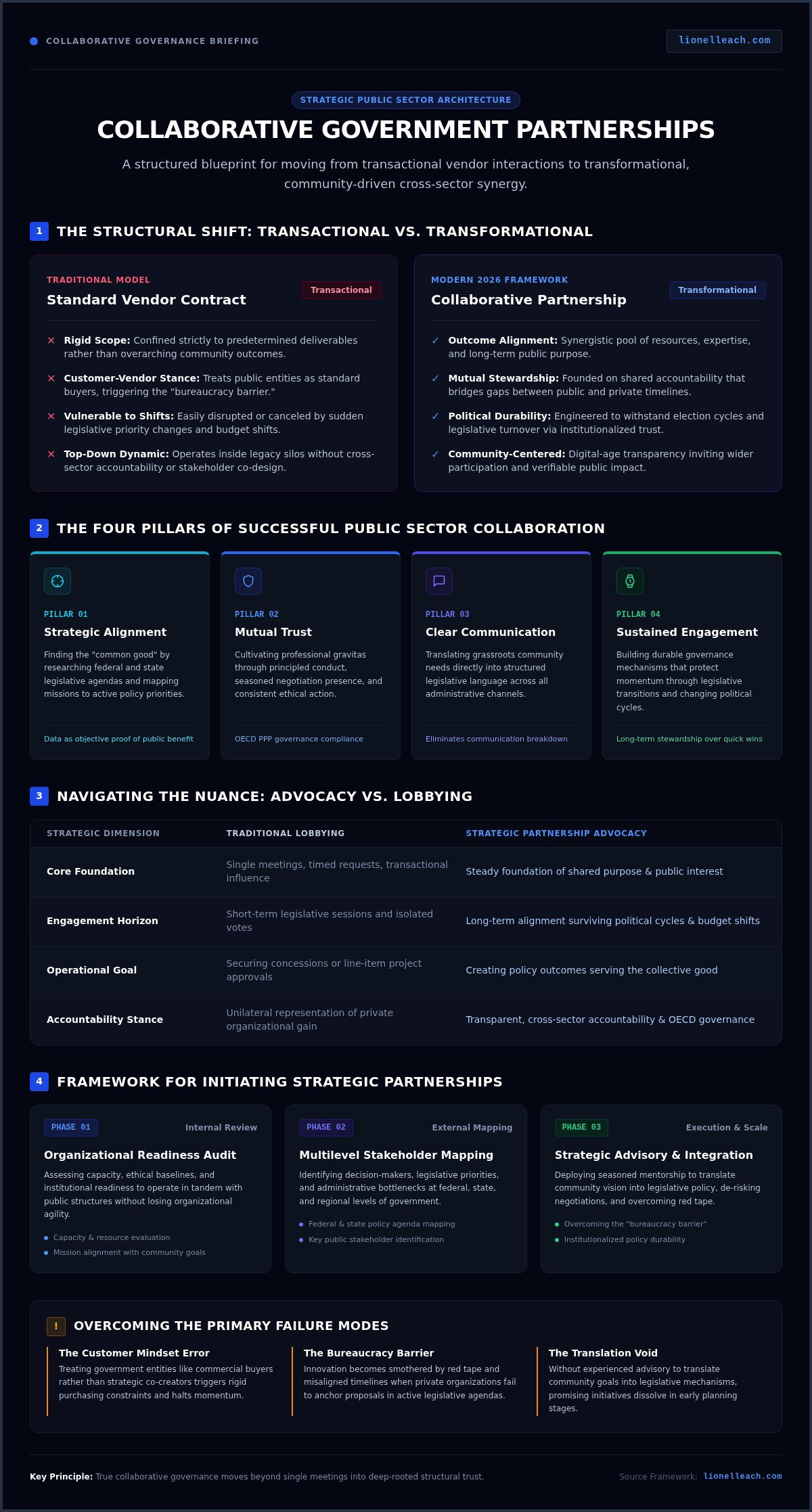
At its core, a collaborative government partnership is a synergistic relationship where public entities and private organizations work in tandem toward a shared vision. These aren't simple transactions where a service is bought and delivered. Instead, they represent a deep alignment of resources, expertise, and community-centered goals. As we look toward 2026, these partnerships have become essential for meeting complex community development objectives that no single sector can address alone. True collaboration requires a move away from the transactional and toward the transformational.
There is a distinct difference between a standard vendor contract and a strategic collaboration. A contract is often rigid and limited in scope, focusing on deliverables rather than outcomes. In contrast, collaborative government partnerships are built on a foundation of mutual stewardship. They require a commitment to long-term impact that survives political cycles and budget shifts. Strategic advisory plays a vital role here, acting as the bridge that translates community needs into legislative priorities and ensures that communication remains clear and consistent across all levels of engagement.
The Evolution of Public-Private Synergy
The days of rigid, top-down mandates are fading. We've moved into an era where policy development is increasingly community-driven, requiring a more nuanced approach to collaborative governance. The digital age has accelerated this shift by providing greater transparency and inviting more voices into the conversation. Today, success depends on cross-sector accountability. Leaders must ensure that every stakeholder is not just present, but actively contributing to the integrity of the project. This evolution demands that we prioritize ethical responsibility and sustainable growth over short-term wins.
Why Traditional Models Often Fail
Many initiatives stall because they treat the public sector like a standard customer rather than a strategic partner. This misunderstanding often leads to the "bureaucracy barrier," where innovation is smothered by red tape and rigid structures. When mission statements are misaligned, trust dissolves quickly. Without professional collaborative government partnerships advisory, organizations often struggle to translate their community goals into a language that resonates with legislative structures. This lack of strategic advocacy is why so many well-intentioned programs fail to move past the initial planning phase. Success requires a seasoned mentor who understands the nuances of negotiation and the human element of professional service.
The Four Pillars of Successful Public Sector Collaboration
Building collaborative government partnerships is an intentional process. It moves beyond the excitement of a new idea into the disciplined work of structural alignment. Four core pillars support this work: strategic alignment, mutual trust, clear communication, and sustained engagement. Without these supports, even the most well-funded projects can crumble under the weight of shifting political winds. Each pillar serves as a bridge between private innovation and public responsibility.
Strategic Alignment: Finding the "Common Good"
Researching legislative agendas at federal and state levels is the first step. You can't propose a solution if you don't understand the problem the government is currently trying to solve. Map your organization's mission to existing policy goals to ensure you're rowing in the same direction as public officials. Data is your strongest ally here. It provides the objective proof that your partnership offers a measurable public benefit. When your goals mirror the public interest, you create a compelling case for cooperation that's hard to ignore.
Building Trust Through Professional Gravitas
Trust isn't granted; it's earned through consistent, ethical action. In high-stakes negotiations, seasoned leadership provides the professional gravitas necessary to command respect. Adhering to the OECD principles for public governance of public-private partnerships ensures that your engagement remains transparent and accountable. This commitment to integrity helps establish a track record of reliability. If you're looking for guidance on how to build these foundational relationships, a government partnership advisory can help you navigate these nuances with a principled approach.
Translating community needs into "government-speak" is about more than just vocabulary. It's about framing your request in a way that fits within existing budgetary and regulatory constraints. You must speak the language of the boardroom and the community hall simultaneously. Finally, sustained engagement means looking beyond the current project. True success is found when you move from a one-off initiative toward long-term policy change that benefits the community for decades. This steady, composed approach builds the kind of legacy that defines a leader's career.
Strategic Advocacy vs. Traditional Lobbying: Navigating the Nuance
Distinguishing between traditional lobbying and strategic advocacy is vital for any community leader. While lobbying often focuses on a specific legislative "ask" for a fee, strategic advocacy is a more comprehensive, mission-driven approach. It centers on policy development, community education, and long-term alignment. By focusing on these enduring goals rather than short-term wins, organizations can foster collaborative government partnerships that are built on shared values rather than mere transactions. This approach ensures your voice remains authentic and your goals remain centered on the people you serve. It's about building a case for change that stands on its own merits without the need for aggressive tactics.
The Role of the Strategic Advisor
A strategic advisor with over 35 years of experience serves as a mentor who understands the nuances of negotiation. They don't replace your voice; they amplify it. They provide the roadmap needed to move through complex government structures without the need for a registered lobbyist or legal representation. This involves drafting bill concepts and policy frameworks that reflect community needs, which is quite different from formal legal drafting. It's about giving leaders the tools to stand in the boardroom and speak for themselves with confidence. This guidance follows established best practices, such as the GAO framework for interagency collaboration, which emphasizes shared outcomes and structured accountability. This framework helps you build a system of mutual responsibility that protects the integrity of your efforts.
Empowering Community Voices through Voter Outreach
Voter outreach is a powerful tool for legitimate policy influence and community development. In government affairs, civic participation is the ultimate currency. When you design outreach programs that increase the "weight" of a community’s voice, you create a mandate that officials can't ignore. This isn't about campaign management; it's about mobilization, education, and collective empowerment. Successful national community-driven initiatives have shifted policy by demonstrating broad public support through structured engagement and voter education. By mobilizing the collective, you ensure that collaborative government partnerships are responsive to the actual needs of the people. This process requires careful planning and a deep commitment to ethical responsibility. It allows your organization to remain a powerful force for community growth while maintaining strict compliance with all procedural requirements.
A Step-by-Step Framework for Initiating Partnerships
Initiating collaborative government partnerships requires a disciplined approach that begins long before you enter a legislative office. The first phase is an internal audit. You must honestly assess your organization's readiness and clearly define your "ask." It's not enough to have a good idea; you need the operational capacity to support a public initiative. This initial self-reflection ensures that when you finally approach a government entity, your proposal is grounded in reality and backed by a solid organizational foundation.
Stakeholder Mapping: Who to Talk To
Understanding the hierarchy of local, state, and federal jurisdictions is essential. Each level has different priorities and budget cycles. While it's tempting to focus only on elected officials, identifying "champions" within the executive branch is often more effective for long-term success. Don't overlook career civil servants. These professionals provide the institutional memory and technical expertise that keep programs running through political transitions. Building a relationship with these individuals ensures your project has the technical support it needs to survive beyond the next election cycle.
Crafting the Persuasive Brief
Your strategic briefing must focus on the public interest rather than private gain. Government officials are looking for solutions to public problems, not ways to subsidize private ventures. Using 35 years of legislative insight allows us to anticipate government objections before they're even raised. A strong proposal should emphasize shared risk and shared reward. It should demonstrate how the partnership will deliver measurable benefits to the community while being fiscally responsible. If you need help refining your message, our Government Partnership Advisory can guide you through this critical stage.
Once a verbal agreement is reached, you must move toward formalization. This involves creating a structured partnership with clear roles, responsibilities, and accountability mechanisms. Finally, the evaluation and scaling phase is where you prove your impact. By documenting your successes and showing a clear return on the public's investment, you secure the continued support needed to grow your initiative. This methodical process turns a simple idea into a sustainable community asset that serves the collective good.
Scaling Impact through Professional Partnership Advisory
Scaling the impact of your initiatives requires more than just passion; it demands a sophisticated understanding of how systems function at scale. Many community leaders reach a plateau where the sheer volume of legislative complexity becomes a barrier to progress. Choosing a professional advisory service allows you to bypass the steep learning curve of government affairs. With the right mentorship, you gain access to a reservoir of knowledge built over 35 years of drafting bills and mobilizing communities. This expertise helps you transition from managing a single project to establishing a permanent civic engagement framework that serves the collective good.
The value of a seasoned mentor lies in their ability to see the patterns that others miss. They've seen how policy cycles fluctuate and how different administrations approach collaborative government partnerships. This depth of experience is vital when you're trying to build something that lasts. It's about moving beyond the transactional and into the transformational. When you have a trusted advisor by your side, you're not just reacting to changes; you're anticipating them with a calm and principled confidence.
The Long-Term Value of Strategic Guidance
Common pitfalls often derail partnerships in their first year, usually because of a lack of clear structure or misaligned expectations. Strategic guidance provides the necessary guardrails to keep your project on track. It helps you maintain momentum across changes in political leadership by focusing on the enduring needs of the community. This approach builds a legacy of civic participation that isn't dependent on any single elected official. By prioritizing ethical responsibility and sustainable growth, you ensure that your partnership remains a powerful force for community development for decades to come.
Next Steps for Community Leaders
Take a moment to evaluate your current government relations strategy. Are you speaking the language of your public partners, or are you struggling to bridge the communication gap? In 2026, the most successful leaders will be those who lead with integrity and a clear sense of mission. The future of collaborative governance in the United States depends on our ability to align private innovation with the public interest. If you want to strengthen your approach and build more resilient collaborative government partnerships, you can consult with Lionel Leach on your partnership strategy today. Together, we can create a roadmap for your organization's long-term success.
Building a Legacy of Shared Success
Building a legacy of shared success requires more than a good idea; it requires a disciplined commitment to the collective good. We've explored how collaborative government partnerships thrive when they're rooted in strategic alignment and mutual trust. By moving from transactional vendor models to mission-driven advocacy, you ensure your community's voice is heard at every level of government. This steady, methodical approach turns short-term projects into sustainable civic frameworks.
Navigating these complex structures doesn't have to be a solitary journey. With over 35 years of legislative leadership and a deep background in voter outreach, I provide the principled guidance needed to turn your vision into reality. Success in 2026 and beyond will belong to those who prioritize ethical responsibility and long-term community impact. It's about having the right roadmap and the seasoned mentorship to follow it through every political cycle.
If you're ready to scale your impact and bridge the gap between community needs and policy outcomes, partner with a seasoned expert for your Government Partnership Advisory. The path to meaningful change is open, and with a principled strategy, your organization can lead the way toward a stronger future.
Frequently Asked Questions
What is the difference between a public-private partnership and a collaborative government partnership?
Public-private partnerships often focus on infrastructure and financing, while collaborative government partnerships emphasize shared policy goals and community-centered alignment. A standard PPP is frequently a contractual arrangement for a specific asset or service. In contrast, collaborative partnerships are synergistic relationships that prioritize long-term social impact and strategic advocacy. These partnerships rely on a deep alignment of mission and values rather than just a financial transaction or a vendor contract.
How can a small community group get the attention of federal or state government officials?
Small community groups gain attention by aligning their local needs with broader state or federal legislative priorities. It's essential to present your initiative as a scalable solution to a public problem. Providing clear data and demonstrating strong community support through voter outreach can make your organization's voice much more persuasive. Mapping the right stakeholders at the executive and legislative levels ensures your message reaches decision-makers who already share your community goals.
Does our organization need a registered lobbyist to build a government partnership?
No, organizations often build successful partnerships through strategic advocacy and advisory services rather than traditional lobbying. While lobbying focuses on specific fee-based requests, strategic advisory provides the roadmap for community leaders to speak for themselves. This approach centers on policy development and community education. It's important to note that our services facilitate these connections without providing legal representation or lobbying registration services, ensuring you maintain a principled and mission-driven approach.
What are the most common reasons government partnerships fail?
Most government partnerships fail due to a lack of trust, misaligned timelines, or a failure to translate community needs into actionable policy. When the public and private sectors operate with different priorities, the bureaucracy barrier often stalls innovation. A lack of professional guidance can lead to misunderstandings of legislative structures. Successful collaborative government partnerships require transparent communication and a shared commitment to long-term community development rather than short-term individual gains.
How do we measure the success of a collaborative policy initiative?
Success is measured through a combination of qualitative community impact and quantitative policy outcomes. You should track specific metrics like increased civic participation, the successful implementation of community programs, or the passage of supportive legislation. Establishing clear accountability mechanisms early in the partnership ensures that both parties can prove the value of their collaboration. Long-term success is ultimately defined by the sustainability of the development and the continued support of the community stakeholders.
How long does it typically take to establish a formal partnership with a government entity?
Establishing a formal partnership typically takes six to eighteen months, depending on the complexity of the legislative cycle and the level of jurisdiction. This timeline includes the initial internal audit, stakeholder mapping, and the formalization of structural agreements. It's a methodical process that requires patience and steady leadership. Moving too quickly can lead to structural weaknesses, while a deliberate approach ensures the partnership is resilient enough to survive changes in political leadership.
Can collaborative partnerships help with community development and voter outreach?
Yes, these partnerships are highly effective tools for driving sustainable community development and robust voter outreach. By aligning public resources with community-driven strategies, organizations can increase civic engagement and empower local voices. Collaborative government partnerships provide the framework for mobilization and education, ensuring that development goals reflect the actual needs of the people. This synergy creates a powerful mandate for positive change that benefits the collective rather than just a few individual interests.
What role does strategic advisory play in navigating government red tape?
Strategic advisory acts as a bridge, helping community leaders navigate complex government structures and bureaucratic red tape with confidence. An advisor with over 35 years of experience understands the nuances of negotiation and the human element of professional service. They provide the roadmap needed to move past administrative hurdles and ensure that communication remains clear across all sectors. This guidance allows you to focus on your mission while maintaining a steady pace toward your goals.



Comments