Negotiation Skills for Advocates: Lessons from Labor Advocacy

Effective negotiation isn’t about making the biggest demand. It’s about turning shared priorities into an agreement people can use. I’ve learned that through labor advocacy, including negotiating contracts for 36,000 state workers. Those experiences shaped the negotiation skills for advocates I rely on: preparation, trust, and a clear understanding of whom I represent.
Balancing different community priorities or negotiating with established institutions can be difficult. I prepare by identifying what matters most, building working relationships, and keeping conversations focused on practical outcomes. In this article, I’ll connect those lessons to my public-service experience and the needs of Orange, so you can see how steady, community-centered negotiation can help turn advocacy demands into agreements that reflect people’s priorities.
Table of Contents
What negotiation skills for advocates turn a community priority into a shared agenda?
Representing a community means carrying people’s needs into a room where priorities may differ. I need to speak clearly for the people who trust me while staying ready to listen, ask questions, and identify common ground. That balance is central to negotiation skills for advocates: firmness about what matters, paired with care in how I pursue it.
I approach advocacy negotiation as a process: express priorities, listen to other perspectives, and work toward an agreement people can put into practice. A demand alone doesn’t make a shared agenda. I need to understand the interests beneath each position, explain what the community needs, and explore options without losing sight of those priorities. These Negotiation principles and strategies offer useful context for thinking about how people reach agreements across different settings.
Resistance is part of that work. This video considers how to respond when a negotiation doesn’t go your way:
How I learned to negotiate across government, labor, and community settings
I learned directly from Mayor Sharpe James, Congressman Donald Payne, Assemblyman Tucker, Newark Councilman Branch, and Mayor Robert Bowser. Their examples helped me understand that public leadership requires preparation, sound judgment, and attention to the people affected by a decision. Lt. Governor Sheila Oliver was also a close mentor. Her example reinforced the importance of principled, community-centered leadership: listening with respect, acting with integrity, and keeping the public good in view.
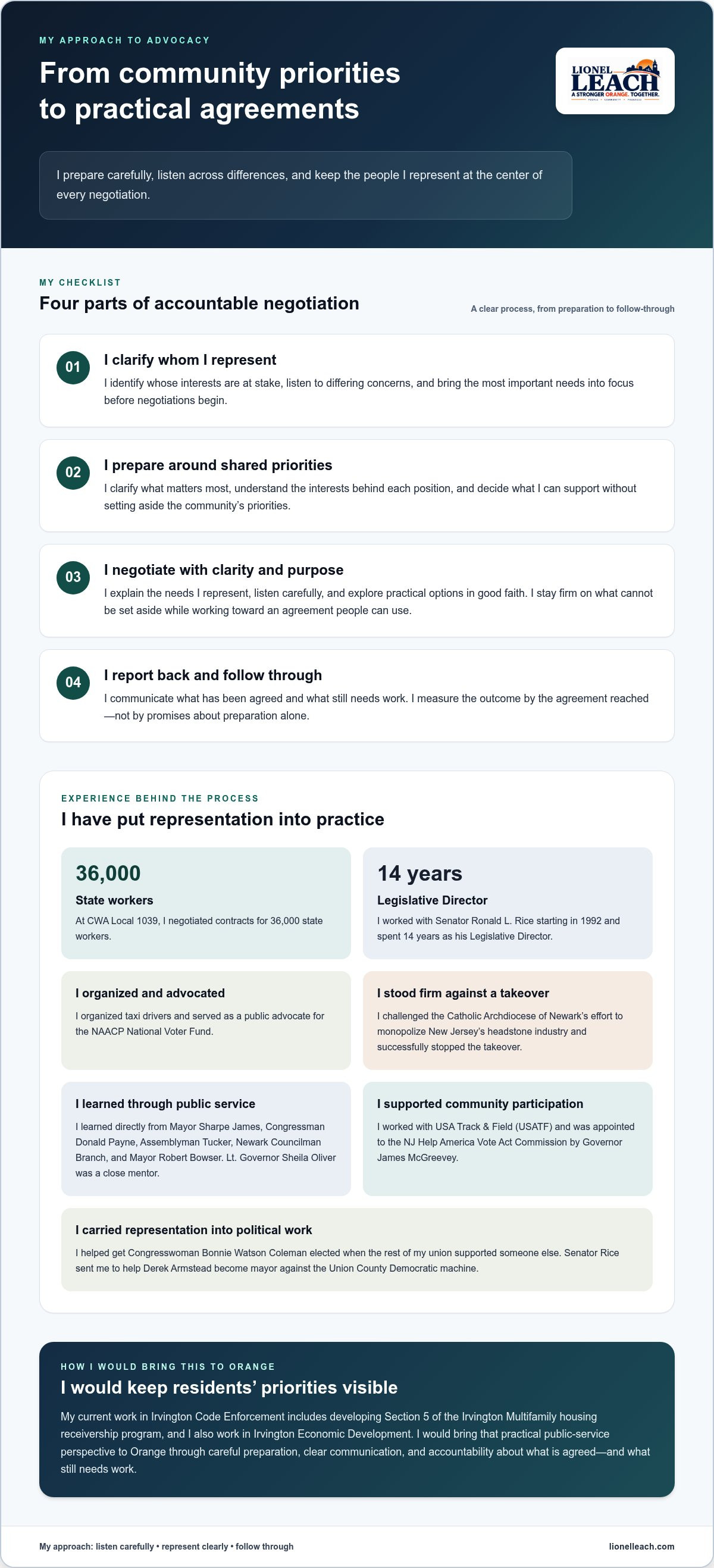
That approach guides my labor advocacy and my work with Senator Ronald L. Rice. I worked with Senator Rice starting in 1992 and spent 14 years as his Legislative Director. I don’t treat negotiation as a contest to win at any cost. Principled negotiation protects the represented group’s priorities while exploring practical options. That means being clear about what cannot be set aside and creative about ways to reach an agreement others can support.
How I used negotiation skills for advocates in labor and community work
In my labor work, I learned that representing a large group starts well before people sit down to negotiate. I first need to understand whom I represent, clarify what matters most, prepare carefully, negotiate around those priorities, and report back. This sequence keeps the process accountable to the people whose interests are at stake.
At CWA Local 1039, I negotiated contracts for 36,000 state workers. The work called for preparation and a clear focus on representation, without losing sight of the people behind each issue. Preparation helps me represent workers with clarity, while the outcome must be judged by the agreement reached, not by promises about what preparation alone can achieve. That distinction is central to negotiation skills for advocates: understand priorities, engage in good faith, and be precise about what the process has and has not delivered.
What organizing taught me about trust, leverage, and representation
My experience representing people has taken different forms. Through taxi organizing, I worked on representation for taxi drivers. As a public advocate for the NAACP National Voter Fund, I worked on voter advocacy. Each role reinforced the need to listen closely and make the people represented visible in decisions that affect them.
I also challenged the Catholic Archdiocese of Newark over its effort to monopolize New Jersey’s headstone industry, and I successfully stopped the takeover. That experience taught me that advocacy sometimes means standing firm when an institution has considerable influence. To prepare for a negotiation like this, I focus on the issue at stake, whose interests are affected, and what outcome would address the concern. I also consider what I can support and where I need to hold my position.
In political work, I helped get Congresswoman Bonnie Watson Coleman elected when the rest of my union supported someone else. Senator Rice also sent me to help Derek Armstead become mayor against the Union County Democratic machine. Those experiences strengthened my resolve to represent the people and priorities I’m entrusted with, even when the path isn’t the easiest one.
That commitment informs my community-focused public-service work and the way I think about representation in Orange.
How I would apply advocacy negotiation lessons to Orange, New Jersey
In Orange, I would bring negotiation skills for advocates to local priorities by starting with residents’ concerns, identifying what matters most, and keeping those priorities visible in discussions with government partners. Listening is only the beginning. I would communicate what’s being considered, explain how decisions connect to community needs, and remain accountable as work moves forward. Collaboration matters, but it needs a clear purpose: practical progress that reflects the people affected.
My current work in Irvington Code Enforcement includes developing Section 5 of the Irvington Multifamily housing receivership program, and I also work in Irvington Economic Development. That experience keeps me engaged with the practical details of public service. I would bring that perspective to Orange through careful preparation, clear communication, and partnerships grounded in residents’ priorities. I would also be clear about what has been agreed and what still needs work, rather than promising outcomes before the work is done.
How my wider experience informs community-centered public service
My work with USA Track & Field (USATF), my appointment to the NJ Help America Vote Act Commission by Governor James McGreevey, and my voter outreach experience have each connected me with community participation in different ways. I also helped elect Congresswoman Bonnie Watson Coleman and, at Senator Rice’s direction, supported Derek Armstead in his effort to become mayor. These experiences reinforce the value of listening, organizing, and staying focused on the people represented.
I also know how personal loss can change a person’s sense of purpose. I lost my mother, Senator Ronald Rice, and Lt. Governor Sheila Oliver within a 4-month time span. My mother and Sheila Oliver died within 24 hours of each other. They were part of my backbone, and losing them changed my life. I’ve had to find my footing again while carrying forward the lessons they gave me.
My approach to Orange’s future is rooted in this experience and in service. Explore my community development and public-service work to learn more about the principles I would bring to the community.
Carry community priorities into the next conversation
Strong advocacy begins before anyone sits down at the table. I encourage residents to name the issue that matters most, consider who is affected, and be clear about what meaningful progress would look like. Those steps can turn a concern into a focused conversation and give public decision-makers a clearer basis for working together.
For Orange, I believe public service should make room for residents to shape priorities, understand decisions, and stay part of the process as solutions develop. Negotiation skills for advocates matter most when they help communities move from being heard to having a meaningful role in what happens next. That work takes patience, honest communication, and a shared commitment to practical progress.
I invite you to explore my community development and public-service work and join me in keeping community priorities at the center of Orange’s future. Let’s keep the conversation moving and work toward public service that reflects the people of Orange.
Frequently Asked Questions
Is negotiation the same as lobbying?
No. I use negotiation to describe discussions aimed at reaching an agreement between parties. Lobbying generally means advocating to influence public decisions or policy. The activities can overlap, but they have different immediate aims. In Orange, I would be clear whether a conversation concerns a specific community agreement or broader policy change, so residents understand what I’m asking decision-makers to consider.
What should an advocate do when negotiations stall?
When talks stall, I would pinpoint the unresolved issue rather than repeat every demand. I’d ask what concern is blocking progress, consider whether another option addresses it, and clarify which priorities remain essential. If the discussion needs a pause, I’d use that time to consult the people I represent before considering any change in position. That keeps flexibility from becoming a loss of accountability.
Can an advocate negotiate without being a lawyer?
Yes. I can advocate by communicating community priorities, asking questions, and discussing workable proposals without presenting that role as legal representation. For example, an Orange resident advocating for a neighborhood concern can explain the impact, request a response, and record what was discussed. If a negotiation requires legal advice or representation, I keep that distinct from my community advocacy work.
How can advocates keep the people they represent informed during negotiations?
I’d share concise updates that separate what has been discussed from what has actually been agreed. A useful update can name the open issue, summarize the options under consideration, and state when I’ll provide the next report. In Orange, I’d also make room for residents to correct my understanding or raise a concern before I treat a proposal as reflecting community priorities.



Comments