The Future of Political Representation in Orange, NJ: A Community-First Vision for 2026

What if the future of political representation in Orange were measured not by campaign promises, but by whether residents can see their concerns lead to practical, accountable action? I know people want their voices heard, and they deserve a clear way to judge how a leader listens and follows through.
I’ve worked with Senator Ronald Rice since 1992, including 14 years as his Legislative Director, and I currently serve as a Project Manager for the Essex County Board of Commissioners. My experience in government, voter advocacy, labor, and community organizing has taught me that effective representation starts with listening and requires steady work. In this article, I’ll explore what responsive representation could look like in Orange, how my background could help turn community priorities into action, and how residents can share their concerns and stay engaged.
Table of Contents
What Should the Future of Political Representation in Orange Look Like?
I know residents want their concerns heard and addressed. I won’t assume which issues matter most to each person or neighborhood. A community-first approach begins by asking, listening carefully, and taking residents’ priorities seriously.
To me, responsive representation means more than hearing people out. It means communicating clearly, working with residents and relevant institutions, and explaining what’s moving forward, what’s stalled, and why. The City of Orange, New Jersey has its own history and government context, so representation should be grounded in this city and shaped by the people who live here. I want residents to have a meaningful part in defining what progress should look like.
Experience matters when it helps me serve residents, understand how government works, and bring people together. It isn’t a substitute for listening or accountability. I believe residents should be able to see how their concerns are considered and receive an honest explanation when a request can’t be addressed as hoped.
How can Orange residents evaluate a representative’s approach?
I encourage residents to compare what a representative says with what they do and communicate afterward. Consider whether the representative:
Listens to residents without deciding for them which concerns matter most.
Explains decisions and shares progress or obstacles in clear language.
Works across relevant institutions to address community priorities.
Follows up so residents know what happened after they raised an issue.
Judge specific commitments against your own priorities, then pay attention to whether communication continues after the public meeting or campaign conversation ends. That’s one practical way to assess the future of political representation in orange.
How My Government and Community Experience Can Inform Representation in Orange
I believe residents can assess a representative through a practical sequence: identify the priorities they want addressed, examine relevant experience, ask how the representative will work with others, and expect follow-up. Experience matters most when it helps turn community priorities into informed action, not when it replaces listening.
I’ve worked with Senator Ronald Rice since 1992, serving 14 of those years as Legislative Director. In that role, I drafted 178 pieces of legislation signed into law by the Governor of New Jersey. I bring that legislative perspective alongside my current work as a Project Manager for the Essex County Board of Commissioners. These roles have given me experience in government, but they don’t determine what Orange residents need. That must come from listening to Orange residents.
What does practical government experience bring to local representation?
It can help me understand how policy work and public institutions operate, and how to approach collaboration. My work as Regional and State Director of the NAACP National Voter Fund also informs how I think about voter outreach and civic participation. I would bring these experiences to Orange as tools for serving residents, not as proof of unverified local results.
I encourage residents to consider how a representative connects priorities with partners and keeps people informed. The Community-Engagement Governance discussion offers a useful perspective on shared responsibility between organizations and stakeholders. I also welcome residents who want to learn more about my experience and approach to public service.
For more context, readers can look for my article about legislative work with Senator Ronald L. Rice and my guide to collaborative government partnerships. These experiences inform my perspective, while Orange residents’ priorities should shape the work ahead and the follow-up they can expect.
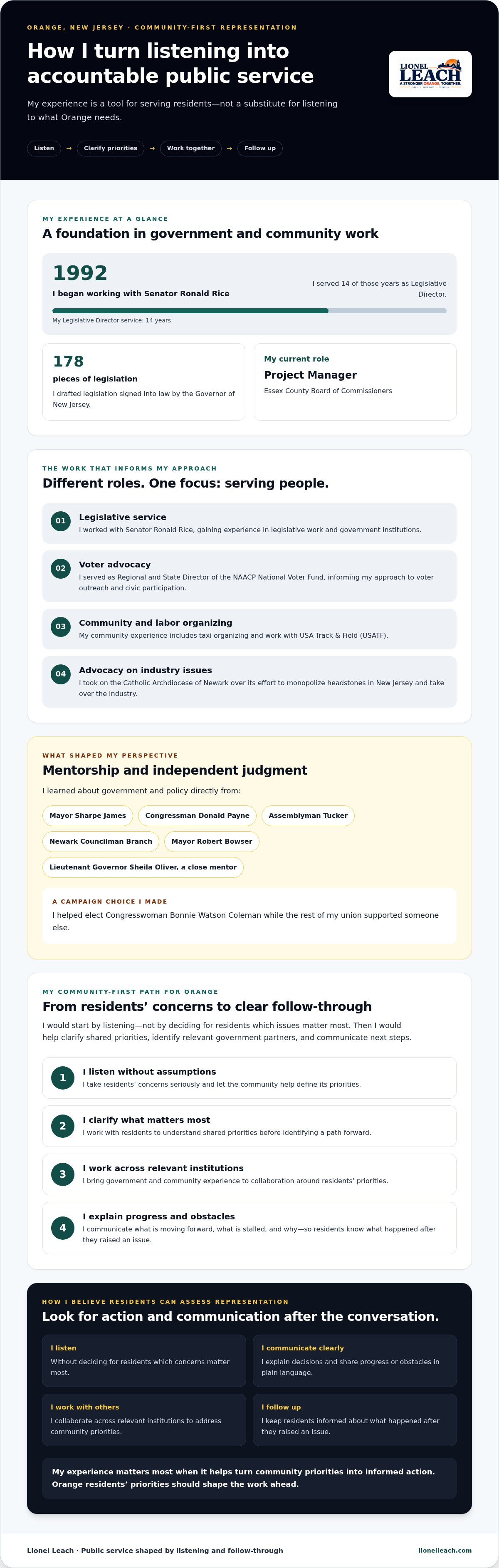
A Community-First Path Forward for Orange, NJ
I believe a practical path forward starts with hearing residents directly, clarifying shared priorities, identifying relevant government partners, and communicating next steps. I would begin by listening rather than assuming which concerns should come first, then keep residents informed about progress and obstacles.
My community experience includes taxi organizing, public advocacy with the NAACP National Voter Fund, and work with USA Track & Field. I also took on the Catholic Archdiocese of Newark over its effort to monopolize headstones in New Jersey and stop it from taking over the industry. My government and policy mentors include Mayor Sharpe James, Congressman Donald Payne, Assemblyman Tucker, Newark Councilman Branch, Mayor Robert Bowser, and Lieutenant Governor Sheila Oliver, who was a close mentor.
My campaign experience has also meant making independent judgments. I helped elect Congresswoman Bonnie Watson Coleman while the rest of my union supported someone else. Senator Rice sent me to help Derek Armstead become mayor against the Union County Democratic machine. These experiences are part of my background, not promises about what I would accomplish in Orange.
What can residents do to shape local representation?
Residents can state their priorities clearly and ask how progress or obstacles will be communicated. My articles on strategic community development planning and voter turnout improvement explore related topics, but Orange residents must define the priorities.
I lost my mother, Ronald Rice, and Sheila Oliver within a 4-month time span. My mother and Sheila Oliver died within 24 hours of each other. They were my backbone, and recovering from that profound loss changed my life. I invite residents to learn about my background and share what matters to them as we consider the future of representation in Orange.
Let’s Shape Orange’s Future Together
The future of political representation in orange should begin with residents’ priorities and be measured by listening, clear communication, collaboration, and follow-through. My experience can inform that work, but it should never replace an honest conversation with the community.
I worked with Senator Ronald L. Rice since 1992 and served 14 of those years as Legislative Director, including from 2008-2022. I now serve as Project Manager for the Essex County Board of Commissioners, a role I’ve held since 2017. I also drafted 178 pieces of legislation signed into law by the Governor of New Jersey. I offer that record as relevant experience, not as a substitute for accountability to Orange residents.
I want to hear what matters to you and understand how you believe local representation should respond. Learn about my experience and share what matters to Orange. Together, we can keep the conversation grounded in community priorities and practical next steps.
Frequently Asked Questions
What does effective political representation in Orange, NJ look like?
Effective representation listens to residents, communicates decisions clearly, works collaboratively, and follows up about progress or obstacles. I believe the future of political representation in orange should be shaped by the priorities residents identify, rather than assumptions about what matters to them. I’d judge a representative not only by experience, but by how consistently that experience is used to serve the community.
How can Orange residents compare candidates for local office?
Compare candidates by looking beyond campaign statements: consider whether they listen to residents, explain their positions, describe how they would work with relevant partners, and communicate after residents raise concerns. I encourage people to compare specific commitments with their own priorities and pay attention to whether candidates explain practical next steps. That offers a clearer basis for judgment than broad promises alone.
How can experience in state or county government help Orange residents?
State and county government experience can provide a working understanding of policy and public institutions, which may help a representative assess options and identify relevant partners. I worked with Senator Ronald Rice since 1992, serving 14 of those years as Legislative Director, and I’m a Project Manager for the Essex County Board of Commissioners. I would bring that experience to Orange while grounding decisions in residents’ priorities.
How can residents make their concerns heard by local representatives?
Residents can state their concerns clearly, explain why an issue matters to them, and ask what follow-up they can expect. I encourage people to share priorities directly with representatives and raise questions at public forums or meetings. Keeping a record of the concern and any response can help residents track communication. I believe continued, respectful engagement helps keep community needs visible in local decision-making.



Comments